

Moving past the single focal point
For decades, the dining room pendant has been treated as the default answer. One centered fitting, dropped above the table, expected to do everything: illuminate food, set mood, and define the space. But, the reality is more nuanced, as rooms are rarely served well by a single light source, especially one fixed at a single height and intensity.
I find a more responsive approach works better because it starts with use rather than object. A dining space is no longer just for eating, it has become a workspace, a gathering point, and often the place where conversations stretch further than intended, which means lighting needs to flex with that rather than resist it.
This is where layered dining room lighting begins to matter, not as a system you install and forget, but as a way of thinking about the room as something composed rather than solved in one move.
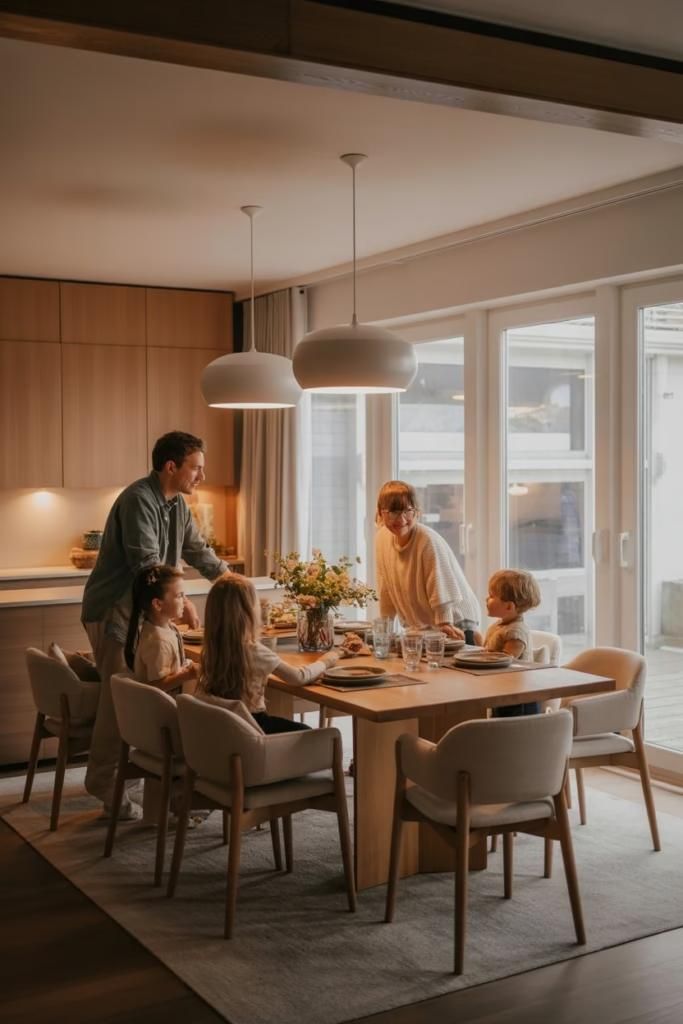

Start with the room, not the fitting
Before choosing fixtures, it helps to actually read the space as it is, not as you hope it will behave. Light already has opinions in every room, it pools in certain corners, disappears in others, changes completely depending on the time of day, and once you start noticing that, the fixture selection becomes secondary.
Are there coves, alcoves, shelving, ceiling shifts? Is the table properly centred in a formal geometry, or sitting loosely inside an open plan arrangement that doesn’t really have boundaries? These conditions matter more than most product decisions.
Instead of asking ‘what pendant should go here’, I usually end up asking something softer, like what the room is already doing well and where it feels slightly under-supported. Morning light might carry it beautifully, while evenings might flatten it, or the other way around depending on orientation.
Either way, the shift is away from object selection and towards spatial behaviour, which is where lighting becomes more interesting.
Build layers that do different jobs
Good lighting is not really about brightness, it is about how light is distributed and how it behaves as it moves across surfaces and through time.
A balanced scheme tends to sit across three overlapping layers, ambient, task, and accent, although in dining spaces they rarely stay neatly separated and that is part of the point.
Ambient light gives the room its general visibility, usually through recessed fittings, concealed LED runs, or wall bounce where the architecture allows it, and its role is less about impact and more about keeping the space readable.
Task lighting at the table is more subtle than it sounds, because in a dining context it is less about precision and more about comfort, making sure food is visible without flattening everything under harsh direction – which is where softer downlighting or indirect angles tend to perform better.
Accent lighting is where things begin to shift emotionally, whether that is a wash across texture, a soft glow inside joinery, or a moment of brightness that sits slightly away from the table and gives the eye somewhere else to rest.
When these layers are working together properly, the table stops behaving like an isolated spotlight moment and instead becomes part of a wider field, which feels calmer and more natural to live with.

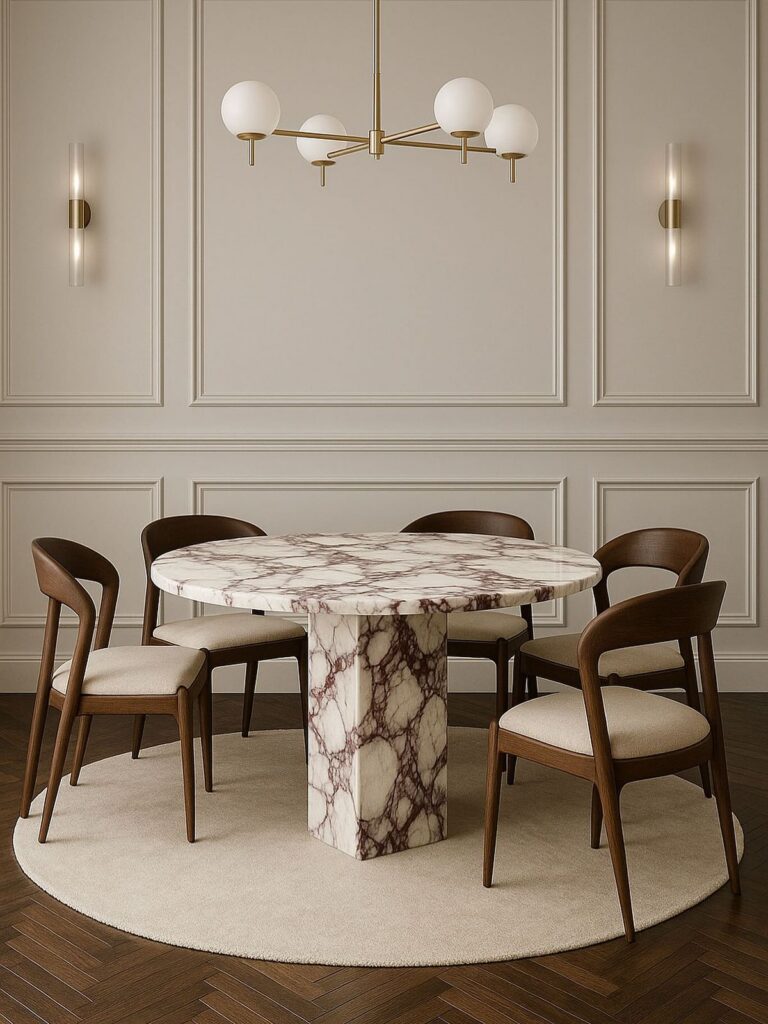
The ceiling is not the only surface that matters
One of the more persistent habits in lighting design is defaulting to the ceiling, because that is where most fittings originate, but it is rarely where atmosphere is actually made.
Walls do a huge amount of work in shaping how a room feels. When you graze light across plaster or timber, the space softens almost immediately because contrast drops and surfaces begin to read as continuous rather than fragmented.
Joinery and shelving can do something slightly different, adding depth without drawing attention to themselves, which subtly pulls the room outward from the table instead of collapsing everything into it.
This is where layered dining room lighting starts to feel less like a theory and more like a spatial condition that you can actually sense when you walk through the space.
Controlling contrast is more important than adding brightness
It is easy to assume that more light will solve a dining room, but it usually does the opposite when it is not carefully distributed.
High contrast between a bright table and a dark perimeter tends to isolate the furniture, almost like it has been placed into a cut-out rather than belonging to the room.
What tends to work better is a softer gradient, where the table remains the brightest point but the surrounding surfaces still participate in the overall field of light rather than dropping away completely.
Dimmers become essential in this context, not as an accessory but as the thing that allows the room to shift character without any physical change at all, which is often what makes a space feel intelligent.
Think in scenes, not settings
It helps to stop thinking of dining light as a fixed condition and instead imagine it as a handful of overlapping scenes that the room can move through without effort.
Breakfast light, working light, evening light, late conversation light, all of them slightly different in balance rather than radically different in setup.
If everything depends on a single pendant, those shifts are limited before you even start, whereas with layered lighting you are simply adjusting emphasis rather than rebuilding the entire atmosphere.
Materials change everything
Lighting never lands in isolation because it is always mediated by surface.
Matte plaster absorbs and softens, satin paint reflects more evenly, oak warms the tone, walnut deepens it, and upholstery shifts how light is perceived at eye level, which means the same lighting scheme can behave very differently depending on what it is interacting with.
This is part of why layered dining room lighting is never entirely fixed, because the room itself is doing half the work of shaping the outcome.

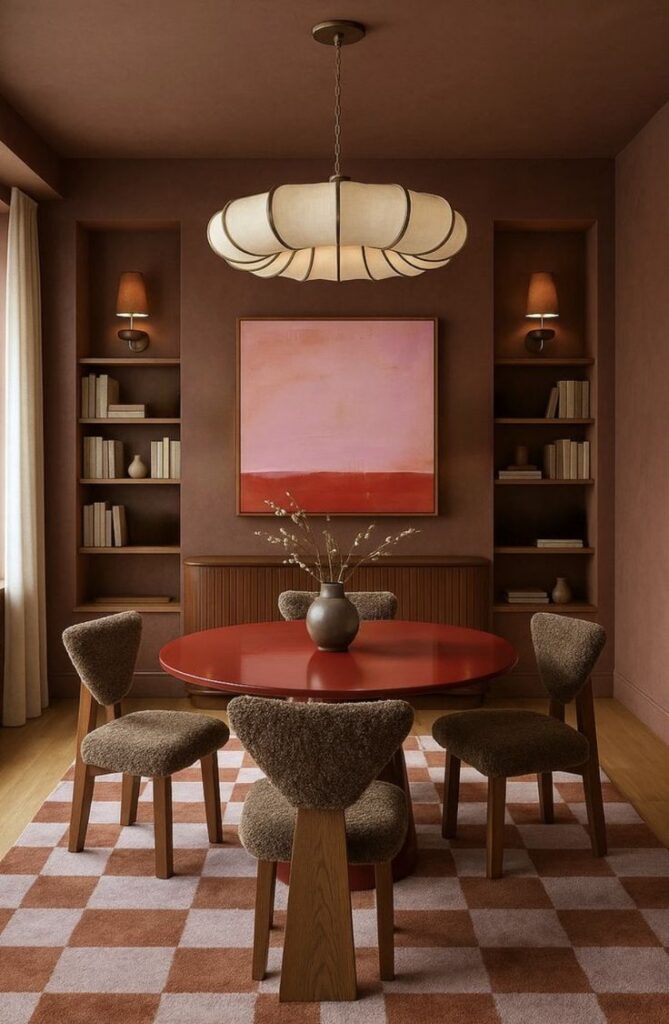
Movement through the space matters
Dining rooms are rarely static, even when they look composed on plan, because people are constantly moving through them, entering, leaving, pausing, carrying things, or simply passing through without engaging with the table at all.
Lighting that only makes sense from a seated position tends to collapse when you experience the room in motion, which is where transitional light, soft perimeter glow, and gentle vertical illumination become important.
It keeps the space legible without flattening it, and ensures it still feels connected to the rest of the home even when it is not actively being used.
When less overhead becomes more intentional
Reducing reliance on a central pendant does not mean removing it entirely, because in many rooms it still carries a useful visual or sculptural role, just no longer the entire responsibility of the space.
Once overhead lighting becomes part of a wider system, it gains freedom to be softer or more atmospheric, and the room usually benefits from that redistribution of weight.
Final thoughts
Dining room lighting rarely settles into a single correct answer because it is always shifting slightly with time, use, and the behaviour of the people in it.
Layered dining room lighting is less a fixed system and more a way of paying attention to how a room actually performs once it is lived in. Sometimes the wall takes the lead, sometimes the table does, sometimes the space between them becomes the most interesting part without any intentional spotlighting at all.
And perhaps the more useful question is not whether the lighting is right or wrong, but what you notice when you stop looking for a solution and start noticing where the room is already trying to go on its own.
Moving past the single focal point
For decades, the dining room pendant has been treated as the default answer. One centered fitting, dropped above the table, expected to do everything: illuminate food, set mood, and define the space. But, the reality is more nuanced, as rooms are rarely served well by a single light source, especially one fixed at a single height and intensity.
I find a more responsive approach works better because it starts with use rather than object. A dining space is no longer just for eating, it has become a workspace, a gathering point, and often the place where conversations stretch further than intended, which means lighting needs to flex with that rather than resist it.
This is where layered dining room lighting begins to matter, not as a system you install and forget, but as a way of thinking about the room as something composed rather than solved in one move.
Start with the room, not the fitting
Before choosing fixtures, it helps to actually read the space as it is, not as you hope it will behave. Light already has opinions in every room, it pools in certain corners, disappears in others, changes completely depending on the time of day, and once you start noticing that, the fixture selection becomes secondary.
Are there coves, alcoves, shelving, ceiling shifts? Is the table properly centred in a formal geometry, or sitting loosely inside an open plan arrangement that doesn’t really have boundaries? These conditions matter more than most product decisions.
Instead of asking ‘what pendant should go here’, I usually end up asking something softer, like what the room is already doing well and where it feels slightly under-supported. Morning light might carry it beautifully, while evenings might flatten it, or the other way around depending on orientation.
Either way, the shift is away from object selection and towards spatial behaviour, which is where lighting becomes more interesting.
Build layers that do different jobs
Good lighting is not really about brightness, it is about how light is distributed and how it behaves as it moves across surfaces and through time.
A balanced scheme tends to sit across three overlapping layers, ambient, task, and accent, although in dining spaces they rarely stay neatly separated and that is part of the point.
Ambient light gives the room its general visibility, usually through recessed fittings, concealed LED runs, or wall bounce where the architecture allows it, and its role is less about impact and more about keeping the space readable.
Task lighting at the table is more subtle than it sounds, because in a dining context it is less about precision and more about comfort, making sure food is visible without flattening everything under harsh direction – which is where softer downlighting or indirect angles tend to perform better.
Accent lighting is where things begin to shift emotionally, whether that is a wash across texture, a soft glow inside joinery, or a moment of brightness that sits slightly away from the table and gives the eye somewhere else to rest.
When these layers are working together properly, the table stops behaving like an isolated spotlight moment and instead becomes part of a wider field, which feels calmer and more natural to live with.
The ceiling is not the only surface that matters
One of the more persistent habits in lighting design is defaulting to the ceiling, because that is where most fittings originate, but it is rarely where atmosphere is actually made.
Walls do a huge amount of work in shaping how a room feels. When you graze light across plaster or timber, the space softens almost immediately because contrast drops and surfaces begin to read as continuous rather than fragmented.
Joinery and shelving can do something slightly different, adding depth without drawing attention to themselves, which subtly pulls the room outward from the table instead of collapsing everything into it.
This is where layered dining room lighting starts to feel less like a theory and more like a spatial condition that you can actually sense when you walk through the space.
Controlling contrast is more important than adding brightness
It is easy to assume that more light will solve a dining room, but it usually does the opposite when it is not carefully distributed.
High contrast between a bright table and a dark perimeter tends to isolate the furniture, almost like it has been placed into a cut-out rather than belonging to the room.
What tends to work better is a softer gradient, where the table remains the brightest point but the surrounding surfaces still participate in the overall field of light rather than dropping away completely.
Dimmers become essential in this context, not as an accessory but as the thing that allows the room to shift character without any physical change at all, which is often what makes a space feel intelligent.
Think in scenes, not settings
It helps to stop thinking of dining light as a fixed condition and instead imagine it as a handful of overlapping scenes that the room can move through without effort.
Breakfast light, working light, evening light, late conversation light, all of them slightly different in balance rather than radically different in setup.
If everything depends on a single pendant, those shifts are limited before you even start, whereas with layered lighting you are simply adjusting emphasis rather than rebuilding the entire atmosphere.
Materials change everything
Lighting never lands in isolation because it is always mediated by surface.
Matte plaster absorbs and softens, satin paint reflects more evenly, oak warms the tone, walnut deepens it, and upholstery shifts how light is perceived at eye level, which means the same lighting scheme can behave very differently depending on what it is interacting with.
This is part of why layered dining room lighting is never entirely fixed, because the room itself is doing half the work of shaping the outcome.
Movement through the space matters
Dining rooms are rarely static, even when they look composed on plan, because people are constantly moving through them, entering, leaving, pausing, carrying things, or simply passing through without engaging with the table at all.
Lighting that only makes sense from a seated position tends to collapse when you experience the room in motion, which is where transitional light, soft perimeter glow, and gentle vertical illumination become important.
It keeps the space legible without flattening it, and ensures it still feels connected to the rest of the home even when it is not actively being used.
When less overhead becomes more intentional
Reducing reliance on a central pendant does not mean removing it entirely, because in many rooms it still carries a useful visual or sculptural role, just no longer the entire responsibility of the space.
Once overhead lighting becomes part of a wider system, it gains freedom to be softer or more atmospheric, and the room usually benefits from that redistribution of weight.
Final thoughts
Dining room lighting rarely settles into a single correct answer because it is always shifting slightly with time, use, and the behaviour of the people in it.
Layered dining room lighting is less a fixed system and more a way of paying attention to how a room actually performs once it is lived in. Sometimes the wall takes the lead, sometimes the table does, sometimes the space between them becomes the most interesting part without any intentional spotlighting at all.
And perhaps the more useful question is not whether the lighting is right or wrong, but what you notice when you stop looking for a solution and start noticing where the room is already trying to go on its own.


LEAVE A COMMENT
Comments