

For a long time, home office lighting has been treated as a simple problem with a simple solution: put a desk near a window, add a lamp, and assume it will behave.
But the reality is more nuanced. Screens dominate most working hours now, daylight shifts constantly through the day, and artificial light is often asked to compensate for both without ever being properly tuned to either.
What tends to matter more is not how much light you have, but how it is distributed, and how it supports sustained focus without quietly exhausting you.
This is where a more layered approach begins to matter, not as a lighting scheme you install once, but as a way of thinking about how attention, posture, and light interact over time.
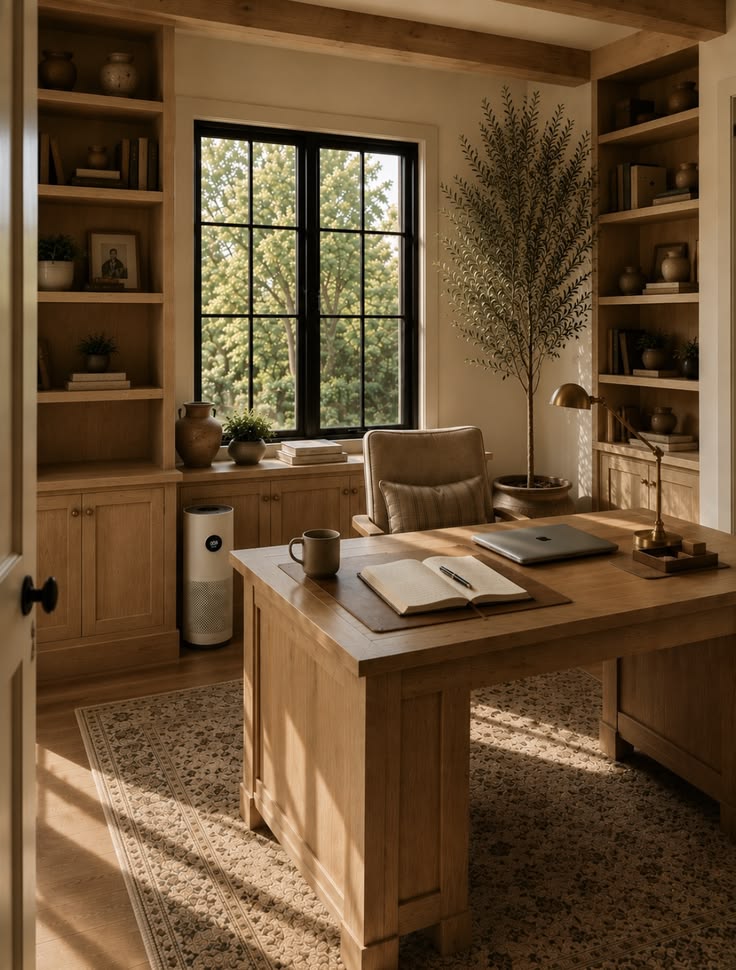
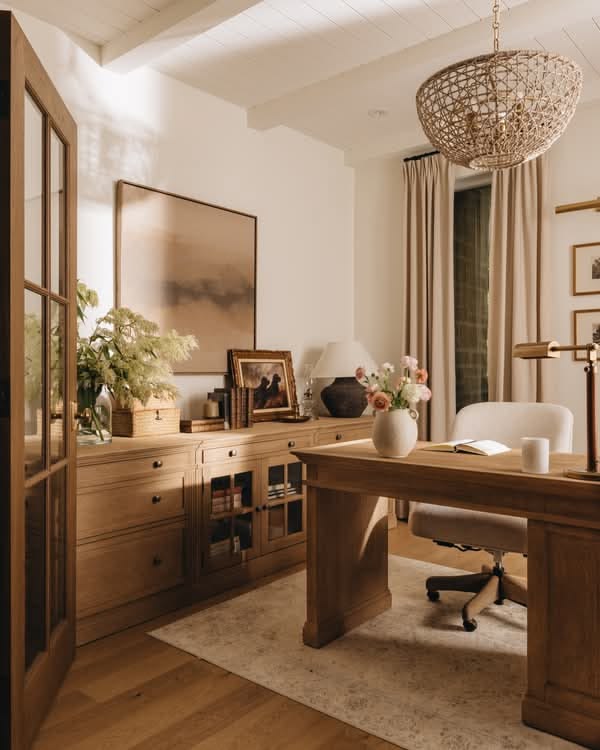
Start with how the room is actually used
Before choosing fittings, it helps to read the space as it behaves in practice rather than how it looks in a plan.
Where does your screen sit relative to the window.? Where does glare appear at different times of day? Which direction does your natural light shift as the hours pass? These small details matter more than any single product decision.
A morning workspace might feel bright and balanced, only to become flat and high contrast by late afternoon when daylight drops and the screen becomes the dominant light source. Or the opposite, where glare dominates early on and forces constant adjustment just to see clearly.
Once you start noticing these shifts, lighting stops being about brightness and becomes about stability.
Build layers that support attention, not just visibility
Good home office lighting is less about illumination and more about preventing fatigue caused by constant visual correction.
A useful approach tends to sit across three overlapping layers, ambient, task, and daylight control, though in practice they rarely behave separately.
Ambient light sets the overall field of the room – this might come from ceiling bounce, wall washing, or soft indirect sources that stop the space from dropping into deep contrast once daylight fades. Its job is not to dominate, but to keep the room visually steady.
Task lighting supports the immediate working area, though in a screen-based environment this is less about brightness on the desk and more about balancing the screen itself against its surroundings. A well-placed, dimmable lamp can reduce strain by lifting peripheral light rather than pushing intensity directly onto the work surface.
Daylight control is often the most overlooked layer, yet it has the greatest impact on fatigue. Sheers, blinds, or adjustable filtering allow daylight to remain present without becoming visually aggressive, which helps prevent the constant pupil and focus adjustment that leads to tiredness.
When these layers work together, the screen stops behaving like a bright isolated object and instead sits comfortably within a wider field of light.
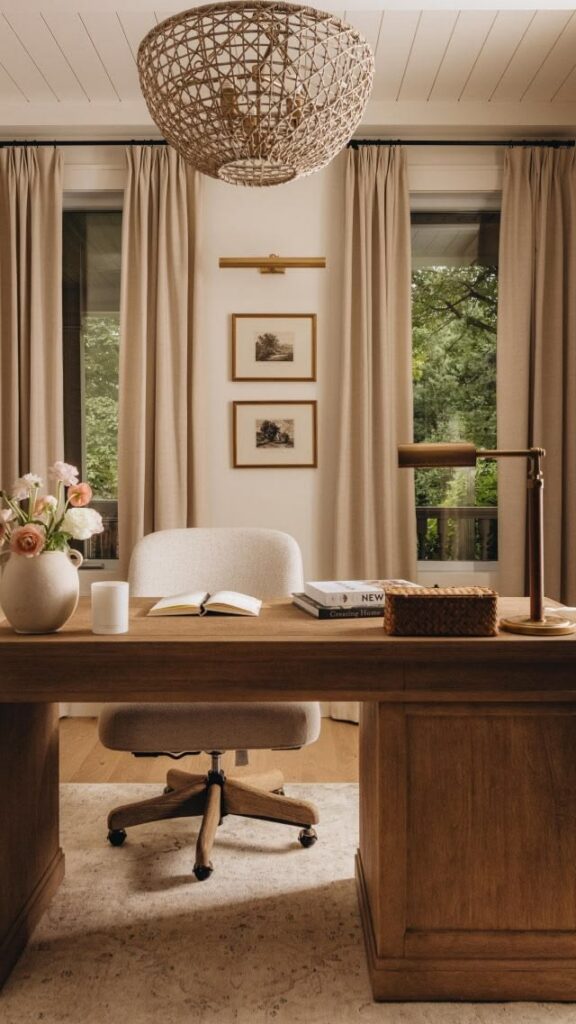
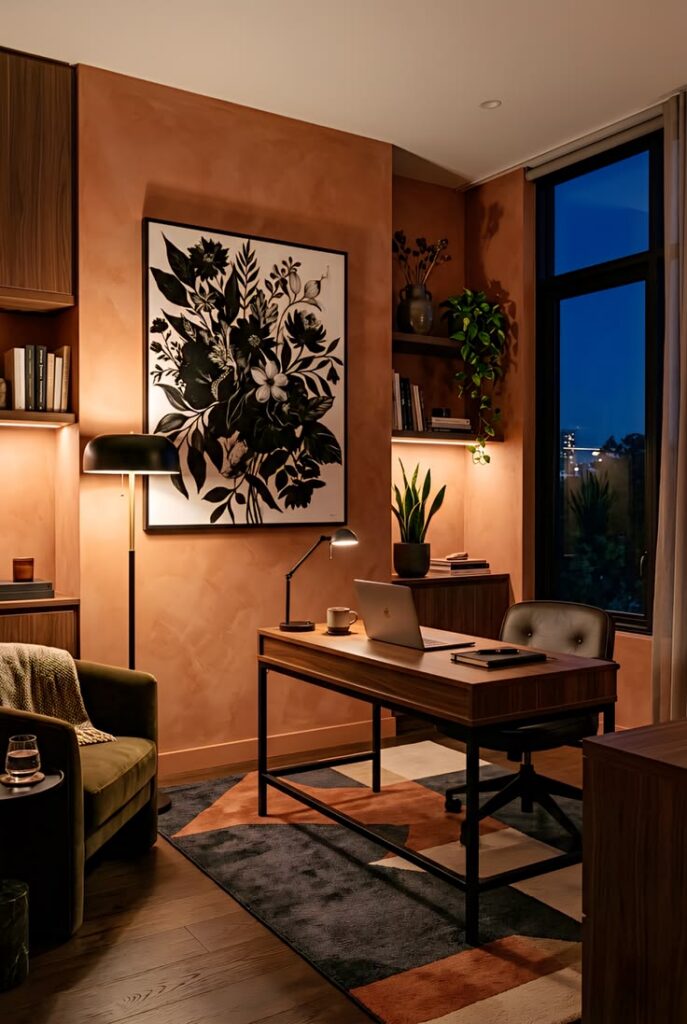
The window is part of the lighting system
Daylight is not a backdrop in a home office, it is an active part of the lighting scheme.
A desk placed directly in front of a window may feel uplifting in theory, but in practice it often creates screen glare and shifting exposure throughout the day. Equally, placing a desk with the window behind you can lead to contrast issues and visual strain.
Side light tends to be the most forgiving, particularly when it can be filtered or softened as conditions change.
Thinking of daylight as something to be shaped rather than simply used is often the shift that makes everything else easier to resolve.
Think in working states, not fixed settings
Office lighting works better when it can shift with the rhythm of the day rather than remaining static.
Focused work, reading, video calls, and low-energy administrative tasks all benefit from slightly different lighting conditions, but not necessarily entirely different setups.
Small adjustments in brightness and direction are often enough. A dimmable task lamp, adjustable blinds, or a secondary ambient source can allow the room to move between these states without feeling reconfigured each time.
This flexibility is what prevents lighting fatigue from accumulating across a long day.
When less overhead becomes more usable
Ceiling lighting is often treated as the primary solution, but in home offices it is rarely the most important layer.
Overhead light can be useful for general visibility, but when it becomes too dominant it tends to flatten depth and increase screen glare. Reducing its intensity, or shifting it to a softer ambient role, often creates a more comfortable working environment.
Once overhead lighting stops carrying the full responsibility of the space, it becomes easier to refine everything else around it.
Final thoughts
Home office lighting rarely resolves into a single correct configuration because it is constantly negotiating between daylight, screen output, and human attention.
A layered approach does not aim to perfect the light in one moment, but to keep it adaptable enough that the room can support you across an entire day without friction building in the background.
Sometimes daylight leads, sometimes the screen takes over, sometimes the room just needs to soften at the edges so focus can hold without strain.
And perhaps the more useful question is not whether the lighting is bright enough, but whether the space still feels easy to inhabit after several hours of being inside it.
For a long time, home office lighting has been treated as a simple problem with a simple solution: put a desk near a window, add a lamp, and assume it will behave.
But the reality is more nuanced. Screens dominate most working hours now, daylight shifts constantly through the day, and artificial light is often asked to compensate for both without ever being properly tuned to either.
What tends to matter more is not how much light you have, but how it is distributed, and how it supports sustained focus without quietly exhausting you.
This is where a more layered approach begins to matter, not as a lighting scheme you install once, but as a way of thinking about how attention, posture, and light interact over time.
Start with how the room is actually used
Before choosing fittings, it helps to read the space as it behaves in practice rather than how it looks in a plan.
Where does your screen sit relative to the window.? Where does glare appear at different times of day? Which direction does your natural light shift as the hours pass? These small details matter more than any single product decision.
A morning workspace might feel bright and balanced, only to become flat and high contrast by late afternoon when daylight drops and the screen becomes the dominant light source. Or the opposite, where glare dominates early on and forces constant adjustment just to see clearly.
Once you start noticing these shifts, lighting stops being about brightness and becomes about stability.
Build layers that support attention, not just visibility
Good home office lighting is less about illumination and more about preventing fatigue caused by constant visual correction.
A useful approach tends to sit across three overlapping layers, ambient, task, and daylight control, though in practice they rarely behave separately.
Ambient light sets the overall field of the room – this might come from ceiling bounce, wall washing, or soft indirect sources that stop the space from dropping into deep contrast once daylight fades. Its job is not to dominate, but to keep the room visually steady.
Task lighting supports the immediate working area, though in a screen-based environment this is less about brightness on the desk and more about balancing the screen itself against its surroundings. A well-placed, dimmable lamp can reduce strain by lifting peripheral light rather than pushing intensity directly onto the work surface.
Daylight control is often the most overlooked layer, yet it has the greatest impact on fatigue. Sheers, blinds, or adjustable filtering allow daylight to remain present without becoming visually aggressive, which helps prevent the constant pupil and focus adjustment that leads to tiredness.
When these layers work together, the screen stops behaving like a bright isolated object and instead sits comfortably within a wider field of light.
The window is part of the lighting system
Daylight is not a backdrop in a home office, it is an active part of the lighting scheme.
A desk placed directly in front of a window may feel uplifting in theory, but in practice it often creates screen glare and shifting exposure throughout the day. Equally, placing a desk with the window behind you can lead to contrast issues and visual strain.
Side light tends to be the most forgiving, particularly when it can be filtered or softened as conditions change.
Thinking of daylight as something to be shaped rather than simply used is often the shift that makes everything else easier to resolve.
Think in working states, not fixed settings
Office lighting works better when it can shift with the rhythm of the day rather than remaining static.
Focused work, reading, video calls, and low-energy administrative tasks all benefit from slightly different lighting conditions, but not necessarily entirely different setups.
Small adjustments in brightness and direction are often enough. A dimmable task lamp, adjustable blinds, or a secondary ambient source can allow the room to move between these states without feeling reconfigured each time.
This flexibility is what prevents lighting fatigue from accumulating across a long day.
When less overhead becomes more usable
Ceiling lighting is often treated as the primary solution, but in home offices it is rarely the most important layer.
Overhead light can be useful for general visibility, but when it becomes too dominant it tends to flatten depth and increase screen glare. Reducing its intensity, or shifting it to a softer ambient role, often creates a more comfortable working environment.
Once overhead lighting stops carrying the full responsibility of the space, it becomes easier to refine everything else around it.
Final thoughts
Home office lighting rarely resolves into a single correct configuration because it is constantly negotiating between daylight, screen output, and human attention.
A layered approach does not aim to perfect the light in one moment, but to keep it adaptable enough that the room can support you across an entire day without friction building in the background.
Sometimes daylight leads, sometimes the screen takes over, sometimes the room just needs to soften at the edges so focus can hold without strain.
And perhaps the more useful question is not whether the lighting is bright enough, but whether the space still feels easy to inhabit after several hours of being inside it.


LEAVE A COMMENT
Comments